
Finding the Best Luxury Liveaboard from Bali for Diving Adventures
- They feature private, air-conditioned cabins with en-suite bathrooms, gourmet dining, and personalized dive guiding.
- Standard charters last from 7 to 12 nights, covering hundreds of nautical miles to destinations like Komodo or Raja Ampat.
- The experience is all-inclusive, encompassing dives, land excursions, and a high crew-to-guest ratio for impeccable service.
The Phinisi Schooner: A Legacy of Seafaring Reimagined
The first thing you notice is the silence. Before the sun crests the volcanic silhouette of Sangeang Api, the only sounds are the gentle lapping of water against the ironwood hull and the soft creak of the rigging. A crew member quietly places a cup of freshly brewed Sumatran coffee on the teak table beside you. This is the dawn of another day on the Indonesian archipelago, an experience that transcends a mere vacation. It is an expedition. And at the heart of this journey is the vessel itself: the Phinisi. These magnificent two-masted schooners, whose boatbuilding artistry is recognized as a UNESCO Intangible Cultural Heritage, are the definitive platforms for any serious marine exploration here. Hand-built by the Konjo people of South Sulawesi, a process that can take up to 24 months and consume over 400 cubic meters of timber, they are floating masterpieces.
But the modern Phinisi is a vessel of two worlds. While its soul and form are ancient, its amenities are purely 21st-century. I recall a conversation with renowned boat designer Jean-Marc Gancille aboard a 55-meter charter, who noted, “We honor the tradition in the lines of the hull and the rigging, but we ensure the guest experience is flawless with redundant navigation systems, watermakers that produce 10,000 liters a day, and dedicated camera rooms with 220V charging stations.” The best luxury liveaboard from Bali isn’t just a boat; it’s a self-sufficient floating resort. It provides access to places otherwise unreachable, combining the romance of old-world sailing with the precision and comfort of modern technology. This fusion is what transforms a simple dive trip into a true luxury expedition.
Charting Your Course: Komodo, Raja Ampat, or the Banda Sea?
While Bali is the world-renowned gateway to Indonesia, the country’s most spectacular underwater realms lie further east, accessible via a short domestic flight to a waiting liveaboard. The choice of destination is the first and most critical decision in planning your charter. Each archipelago offers a profoundly different experience, dictated by its unique geography, marine life, and seasonal patterns. Your selection will define the very character of your voyage.
Komodo National Park: This is the classic, iconic Indonesian dive journey. A quick 60-minute flight from Denpasar to Labuan Bajo places you at the doorstep of this rugged, semi-arid chain of 29 volcanic islands. The diving here is defined by powerful currents, a result of the convergence of the Indian and Pacific Oceans. These currents bring nutrient-rich waters that support a staggering biomass. Sites like Castle Rock and Batu Bolong are electric, with massive schools of giant trevally and fusiliers. Of course, the main draw includes graceful encounters with reef mantas at cleaning stations and the obligatory land excursion to Rinca or Komodo island to see the famed Komodo dragons. The park hosts more than 1,000 species of fish and 260 species of reef-building coral.
Raja Ampat: For the biodiversity connoisseur, Raja Ampat is the undisputed global epicenter. Located off the coast of West Papua, it requires a longer journey but rewards with unparalleled marine density. As the heart of the Coral Triangle, these “Four Kings” islands are home to over 1,600 fish species and 75% of the world’s known coral species. The underwater topography is a dreamscape of swim-throughs, caverns, and vibrant soft coral gardens. A single dive at a site like Cape Kri can reveal more species than are found in the entire Caribbean. A liveaboard bali charter that repositions to this area offers the only practical way to explore its vast, 40,000-square-kilometer expanse.
The Banda Sea: For those seeking true adventure far from any crowds, the Spice Islands of the Banda Sea are the ultimate prize. These are long, open-ocean crossing voyages, typically offered during the transitional months of September-November and March-April when the seas are calmest. The allure here is pelagic action. Divers visit remote atolls and sea mounts to witness schooling scalloped hammerheads, explore sheer volcanic walls, and dive with sea snakes at Gunung Api. The historical weight of the islands, once the world’s only source of nutmeg and mace, adds a fascinating layer to the expedition.
Onboard Experience: Defining “Luxury” at Sea
The term “luxury” is often overused in travel, but on a premier Indonesian Phinisi, it has a tangible meaning. It is not about gold taps and formal service; it is about seamless execution, profound comfort, and unparalleled access. The foundation of this experience is the crew. The best vessels operate with a crew-to-guest ratio that is often better than 1:1. On a typical 12-guest charter, a crew of 15 to 18 is standard. This includes not only the captain and sailors but a cruise director, multiple dive guides, a private chef with assistants, engineers, and dedicated stewards. This level of staffing ensures that every need is anticipated, from a freshly rinsed wetsuit waiting after a dive to a perfectly mixed gin and tonic appearing at sunset.
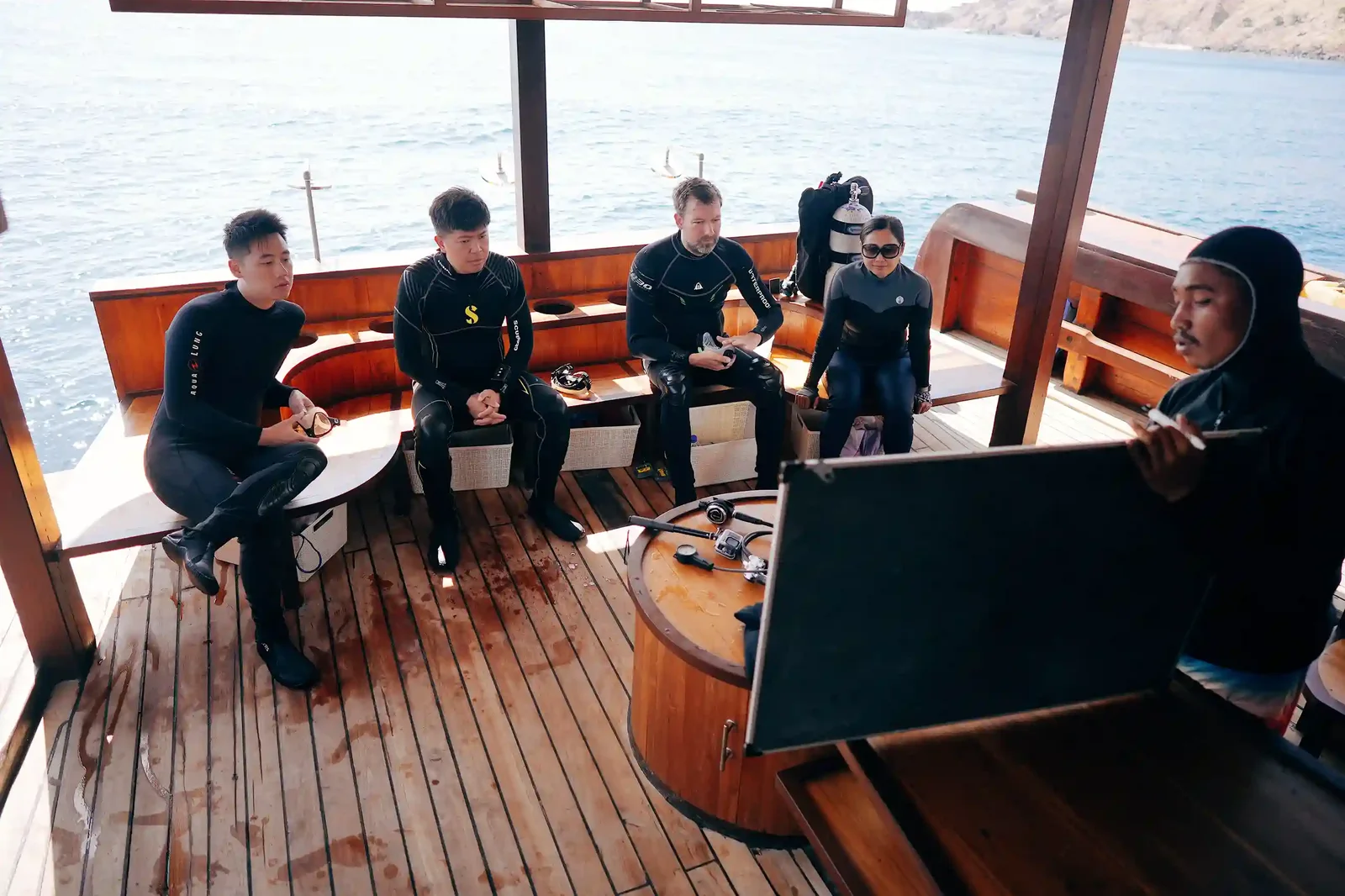
Cuisine is another defining pillar. Forget standard buffet fare. A top-tier liveaboard bali charter functions as a world-class restaurant. Chefs, often with experience in high-end hotels or restaurants in Bali, provision for the entire trip with meticulous care. Menus are a sophisticated blend of Western and Indonesian dishes, using fresh, locally sourced ingredients wherever possible. A day’s meals might include freshly baked pastries for breakfast, grilled reef fish with sambal matah for lunch, and a slow-braised beef rendang for dinner, with dietary requirements catered to flawlessly. The food and beverage budget alone can exceed $200 per guest, per day. The dive operation itself is the final piece. A 1:4 guide-to-diver ratio is the benchmark, ensuring safety and personalized attention. Equipment is top-of-the-line, nitrox is usually available free of charge, and dedicated tenders (zodiacs) ensure precise drop-offs and pick-ups at every dive site. The cruise director, a role I consider the most critical on board, orchestrates this entire symphony, briefing on dive plans, coordinating land excursions, and ensuring the entire experience flows effortlessly for the guests.
The Anatomy of a High-End Charter Itinerary
A well-structured itinerary is a delicate balance of intensive diving and relaxed exploration. It is designed to maximize the unique opportunities of the region while allowing for the serendipitous moments that make a trip unforgettable. A typical 10-day/9-night Komodo charter, for example, is a finely tuned logistical operation. Day one involves the flight from Bali to Labuan Bajo, a swift transfer to the vessel, a comprehensive welcome and safety briefing, and a gentle “check-out” dive in the calm afternoon waters to allow everyone to adjust their weighting and gear. From there, the rhythm of the expedition begins. Days two through eight are typically structured around three to four dives per day. A pre-breakfast dive at 7:00 AM, a mid-morning dive, an afternoon dive, and often, a dusk or night dive to see nocturnal creatures emerge.
The itinerary is not just a list of dive sites; it is a narrative. The cruise director will plan the route to follow the tides, ensuring sites with strong currents are dived at the optimal moment. The journey will physically move through the park, perhaps starting in the north with its clear waters and vibrant reefs, moving central for manta encounters, and then south to the cooler waters around Padar and Rinca. Woven into this diving schedule are the essential surface-interval experiences: a challenging trek up Padar Island for its iconic three-bay view, a walk on the beach at Gili Lawa Darat, and of course, the guided tour on Rinca to safely observe the Komodo dragons. A seasoned captain will always keep an eye out for the unexpected—a pod of pilot whales, a rare dugong sighting—and will not hesitate to alter the plan to create a magical moment. This flexibility is a key differentiator. The cost for such a curated 10-night journey typically ranges from $7,000 to over $15,000 per person, with full private charters of a vessel costing between $80,000 and $150,000 per week.
Selecting Your Vessel: Key Questions to Ask Before Booking
The fleet of Phinisis sailing Indonesian waters is diverse, ranging from rustic backpacker boats to palatial floating villas. Distinguishing between them is crucial. As a prospective charter guest, asking the right questions can mean the difference between a good trip and the journey of a lifetime. The vessel’s specifications are the starting point. Inquire about its length, beam (width), and gross tonnage; larger, heavier boats generally provide a more stable ride in open water. Critically, ask for its build year and the date of its most recent major refit or dry-docking. A well-maintained boat is a safe boat. A vessel that undergoes a comprehensive dry-dock every one to two years is the standard for the luxury segment.
Beyond the hardware, the “software”—the human element—is paramount. Ask for the biography of the Cruise Director. An experienced director with over 1,000 days at sea in a specific region possesses an invaluable, encyclopedic knowledge of the dive sites and their secrets. What is the dive guide-to-guest ratio? As mentioned, 1:4 is the gold standard, ensuring personalized attention underwater. For photographers, this is non-negotiable. Also, what are the dive tender boats like? Are they spacious fiberglass skiffs with proper ladders, or basic inflatable zodiacs? Finally, clarify every detail of the pricing. What is expressly included and excluded? Typically, flights, national park and port fees (which can be over $200 per person), alcohol, and crew gratuity (customarily 10-15% of the charter fee) are extra. Navigating these details is where a trusted charter agent proves its worth. Finding the best luxury liveaboard from Bali requires an expert eye that can match the right vessel, crew, and itinerary to your specific desires.
Quick FAQ: Your Bali Liveaboard Questions Answered
When is the best time to book a liveaboard trip from Bali? The optimal season depends entirely on your chosen destination. For Komodo National Park, the dry season from April through November offers the best conditions with calmer seas and sunny skies. Conversely, Raja Ampat’s prime season runs from October to April, when its waters are at their flattest. The Banda Sea and other specialty “crossing” trips are limited to narrow windows in March-April and September-November, between the monsoons.
Do I need to be an advanced diver? While operators can cater to all certification levels, an Advanced Open Water certification with a minimum of 50 logged dives is highly recommended to fully appreciate the experience. Many of Indonesia’s premier sites, particularly in Komodo, feature strong currents and require confidence and good buoyancy control. Most luxury vessels offer on-board advanced courses if you wish to upgrade your skills during the trip.
How do I get to the boat from Bali? Embarkation rarely happens in Bali itself. For Komodo trips, you will take a 1-hour commercial flight from Denpasar (DPS) to Labuan Bajo (LBJ) on the island of Flores. For Raja Ampat, the journey is longer, involving a flight from Bali to Sorong (SOQ) in West Papua, usually with a layover in a major Indonesian hub like Makassar (UPG). Your charter operator or agent will coordinate these logistics and arrange for airport transfers.
Is specialized dive insurance mandatory? Yes, and for good reason. All reputable liveaboard operators require guests to have comprehensive travel insurance and specific diver’s insurance, such as that offered by DAN (Divers Alert Network). This policy must cover emergency medical evacuation, as you will be operating in extremely remote areas where a helicopter or sea plane evacuation can cost in excess of $50,000.
The Indonesian archipelago, with its more than 17,500 islands as documented by the official tourism board, presents a near-infinite horizon of discovery. To truly penetrate its hidden corners and witness the planet’s most vibrant marine ecosystems requires a vessel capable of navigating both its waters and its complexities. The journey is as important as the destination. Choosing the right Phinisi, the right crew, and the right itinerary is an art form. Navigating the options for the best luxury liveaboard from Bali requires expertise. Let our team of specialists at Liveaboard Bali Charters curate your voyage of a lifetime. Explore our fleet and begin your journey.