Onboard Dining: What Liveaboards Serve
Most Indonesia liveaboards serve 3–5 freshly cooked meals daily plus snacks, drinking water, tea and coffee. Expect Indonesian‑fusion buffets (rice, noodles, grilled fish, vegetables) with Western touches. On higher‑end vessels, a trained chef prepares plated multi‑course dinners and can usually handle vegetarian, vegan, halal and gluten‑free diets with advance notice.
Onboard Dining: What Liveaboards Serve?
On Indonesia liveaboards, food is central to the experience because days are long and water‑activity burns calories fast. From a budget backpacker boat cruise Indonesia in Komodo to a VVIP wooden liveaboard boat Indonesia in Raja Ampat, most follow the same rhythm: light pre‑dive snack, cooked breakfast, lunch, afternoon snack, and dinner.
Menus are typically Indonesian‑fusion. Expect nasi goreng, mie goreng, grilled tuna or snapper, chicken satay, gado‑gado, and sambal alongside pasta, salads, soups and simple desserts. On higher categories, chefs add sushi nights, BBQs, degustation menus, and wine pairings. Since 2015, Komodo Luxury’s network has seen guest feedback consistently rank “food” among the top three satisfaction factors on Komodo boat cruise itineraries, especially for week‑long trips.
Fresh produce and eggs are usually loaded in Labuan Bajo, Sorong or Maumere the day of departure. Fish is often line‑caught en route where regulations allow. Because resupply is difficult, chefs plan menus tightly around trip length, from 3D2N open trips to 10‑night expeditions between Sorong and the Banda Sea.
How does food differ by boat class: budget vs luxury vs VVIP?
Dining quality scales clearly across Indonesia liveaboard boat types. On budget boats, including many open trips in Komodo, meals are hearty buffets: rice, two mains, vegetables, fruit. As of August 2026, Komodo Luxury’s shared 3D2N open trip from around USD 220 per person already includes all meals and drinking water, but not barista coffee, soft drinks or alcohol.
On mid‑range deluxe yachts and traditional phinisi, expect more variety, snacks upgraded to pastries and canapés, and occasional themed dinners. Cabins on these are a step up from basic bunks; luxury vs budget boat cabins on Indonesia liveaboards usually means ensuite bathrooms, better soundproofing and individual climate control, allowing better sleep and appetite.
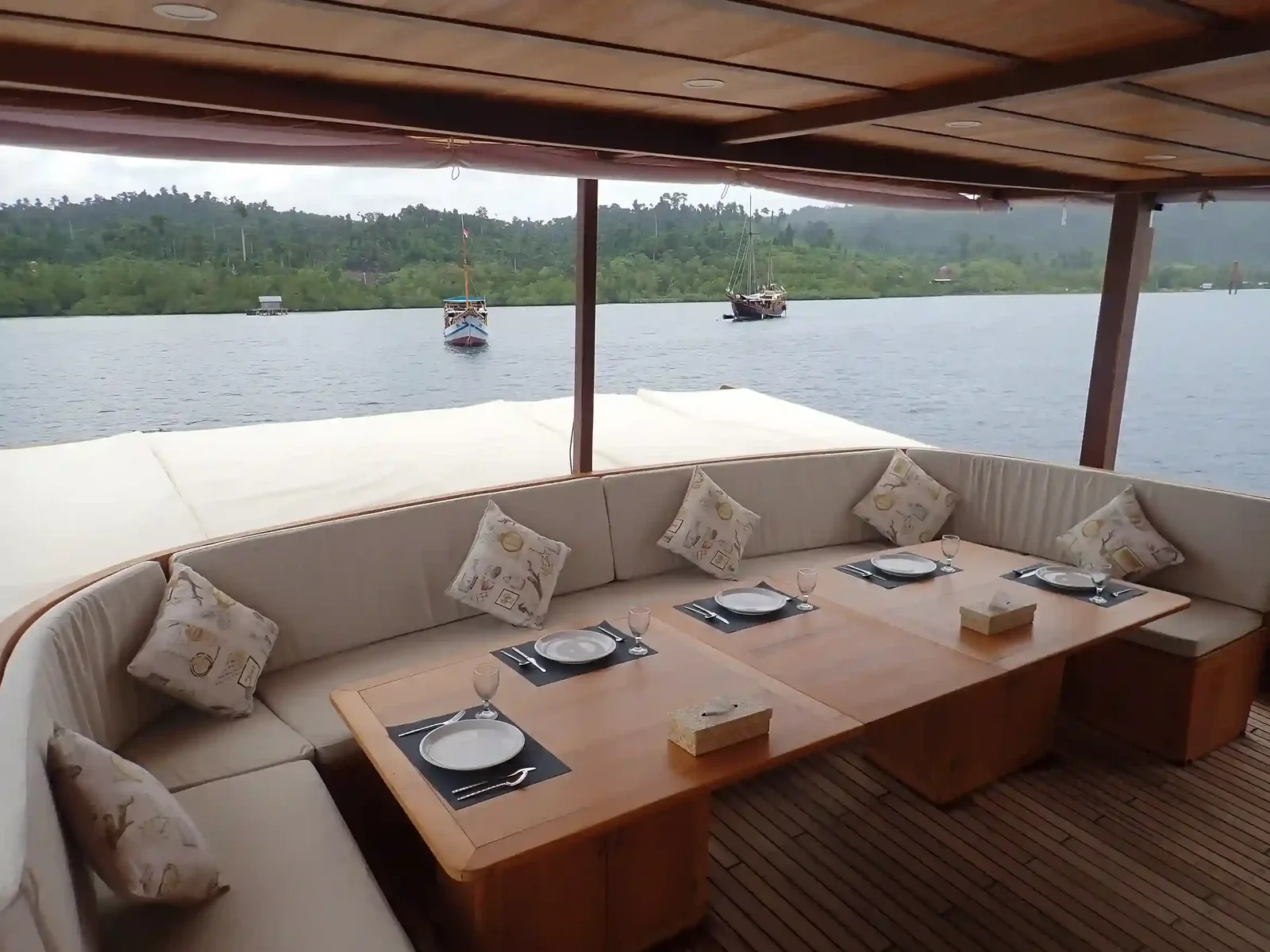
At the VVIP end, where private charters can exceed USD 18,000 per night as of August 2026, chef standards approach boutique hotels. Boats such as Celestia, Lamima, Dunia Baru, Alila Purnama, King Neptune and Manta Mae generally carry professionally trained chefs, pastry options and custom tasting menus. Guests often share dietary files weeks in advance, and kitchen teams plan everything from kids’ menus for a family boat cruise Bali recommendations group to candle‑lit feasts for a Bali honeymoon boat cruise.
How are special diets, allergies and kids’ meals handled at sea?
By 2027, most serious operators in Komodo, Raja Ampat and Alor treat dietary handling as a safety issue, not just hospitality. Food allergies are collected at booking and re‑checked at embarkation, ideally with written notes. This is critical, because resupply is limited once an Indonesia boat safari Komodo itinerary leaves port.
Vegetarian and halal are usually easy: Indonesian cuisine is naturally rice‑ and vegetable‑heavy, and many suppliers in Labuan Bajo and Sorong provide halal‑certified meats. Vegan and gluten‑free are also possible on higher classes, though choices shrink on shorter, lower‑budget backpacker boats. Guests with celiac disease or severe nut allergies should always bring sealed backup snacks and clear written instructions.
Families considering a small boat cruise vs big ship Indonesia often worry about children’s meals. Smaller liveaboards can be more flexible; crews frequently prepare simple pasta, chicken strips, omelettes and fruit plates at off‑menu times. On private charters, galley teams can follow a fixed “kids’ schedule,” which helps on longer legs like a Maumere to Komodo liveaboard crossing or remote Raja Ampat expeditions.
What is the “galley reality” on wooden liveaboards and phinisi?
Traditional phinisi and wooden liveaboard boat Indonesia designs create unique galley challenges. Space is compact, fuel and freshwater are finite, and ventilation must be carefully planned. Many boats now place galleys mid‑ship to improve stability and install fire‑suppression systems to meet evolving phinisi boat safety standards Indonesia guidelines and common insurance requirements.
Cold chains are critical in tropical waters. Larger yachts install multiple marine‑grade fridges and freezers; smaller boats rely on fewer units and more dried goods. For longer routes like an extended Komodo to Banda Sea or bali to raja ampat liveaboard voyage, provisioning lists often run to dozens of line items per guest, from drinking water quotas to eggs per day.
Galley crew sizes scale with guest capacity. A 12‑guest phinisi may run with one chef and one assistant; a 20+ guest boat or VVIP yacht may carry a full brigade. On serious dive expeditions, food timings are plotted around 3–4 dive days and night dives, similar to schedules on advanced trips such as ambon blackwater diving expeditions in the Maluku region.
How do safety standards influence food service on dive liveaboards?
Food handling intersects directly with Indonesia liveaboard diving safety standards. Dehydration and under‑eating raise risk on high‑current dives, especially in Komodo and Alor. Briefings increasingly include hydration reminders, and boats stock isotonic drinks and soups to maintain electrolytes on multi‑dive days.
For night sailing or crossings (for example, repositioning from Komodo’s peak April–November season to Raja Ampat’s October–April window), hot drinks and light snacks help prevent seasickness and fatigue. Kitchens also coordinate closely with dive leaders to avoid heavy, oily lunches immediately before drift dives or cold thermocline sites.
On the structural side, phinisi boat safety standards Indonesia practice now usually places LPG cylinders in ventilated lockers with shut‑off valves and keeps galleys away from emergency exits. Staff are trained in basic food safety and fire response; some VVIP vessels run regular crew drills documented in a simple safety log. For trip planners, it is reasonable to ask operators how kitchens are ventilated and where extinguishers are located during any pre‑booking call.
How does getting to the boat affect what is served onboard?
Access logistics influence what ends up on your plate. For Komodo, the most efficient route is flying from Bali (DPS) to Labuan Bajo (LBJ), about 1h10–1h20 flight time. Comparing Bali to Komodo boat vs plane, flying is almost always faster and kinder to seasick‑prone travellers, while a full Bali to Komodo boat cruise can stretch a week or more and requires heavier provisioning.
As of August 2026, typical Bali to Komodo boat price ranges are broad: shared backpacker boats might cost a few hundred USD for multi‑day transit with simple meals, while curated yacht itineraries run substantially higher. These long routes demand robust cold storage and careful menu planning around limited port calls.
For those starting farther east, a Maumere to Komodo liveaboard allows fresher produce pick‑ups from Flores markets mid‑expedition. In Raja Ampat, most yachts load in Sorong, which has wider supply options, including imported ingredients for gourmet menus. Shorter experiences like a boat cruise Bali sunset charter with canapés will naturally offer lighter selections but still reflect local flavours.
- As of August 2026, Komodo shared 3D2N open trips from Labuan Bajo start around USD 220 per person including meals, drinking water, snorkeling gear and guide (park fees excluded).
- Typical Komodo National Park marine entrance + diver + harbour fees total about IDR 300,000 per foreign diver per day; budget this separately from trip costs.
- Flight time Bali (DPS) to Labuan Bajo (LBJ) runs about 70–80 minutes; most liveaboard departures coordinate boarding windows with midday arrivals.
- Bali sunset boat cruise price for private yachts can vary from mid‑hundreds USD for small groups to several thousand for luxury charters, depending on vessel and inclusions.
- VVIP Indonesia liveaboard charters can exceed USD 18,000 per night as of August 2026, usually including full‑board dining, non‑alcoholic drinks and private chef services.
- Foreign visitors planning an Indonesia boat safari Komodo should keep cash or e‑payments ready for park fees, bar tabs and crew tips, which are not usually included upfront.
- Standard meal rhythm on dive liveaboards: pre‑dive snack, cooked breakfast, lunch, afternoon snack, and dinner, aligned with 3–4 dives per day schedules.
Frequently asked questions
How good is the food on Indonesia liveaboards compared with resorts?
Quality has improved significantly since 2015. On well‑run boats, food now rivals mid‑range island resorts, with the added advantage of ultra‑fresh fish and flexible dining hours. VVIP yachts can exceed resort standards, offering chef‑curated menus and wine lists. Lower‑budget boats remain simpler but still provide filling, freshly cooked Indonesian‑fusion meals.
What luggage to bring on liveaboard boat Indonesia for dining comfort?
Packing light helps in compact cabins. Bring breathable clothes, a light sweater for air‑conditioned salons, reef‑safe toiletries, basic medication, and any hard‑to‑replace snacks for strict diets. Alcohol rules vary; some boats allow sealed duty‑free bottles. Soft bags stow better than hard suitcases, freeing cabin space for safe food and beverage storage.
Can I get romantic or private dinners during a Bali honeymoon boat cruise?
Yes, especially on private yachts and higher‑end phinisi. Crews commonly arrange table set‑ups on the foredeck or upper sundeck, with candles and custom menus. This is more achievable on chartered vessels than shared trips. Onrequest, chefs can create multi‑course tasting menus using seafood, chocolate desserts and local spices for a more intimate experience.
Are there different food setups on small boat cruise vs big ship Indonesia?
Large ships tend to run buffet dining with bigger variety but less customisation. A small boat cruise usually means fewer choices per meal but more flexible timing and tailored dishes, ideal for dive groups or families. On phinisi and boutique yachts, guests can often discuss daily menus directly with chefs and request specific dishes or lighter portions.
How does dining work on a family boat cruise Bali recommendations trip?
For families, operators typically adapt meal times and simplify dishes: early dinners, mild spices, and kid‑friendly favourites. Private charters allow full control over menus, including baby‑food prep or allergen‑free snacks. Between meals, salons offer fruit, biscuits and juices. This flexibility is why many families choose private yacht or phinisi options over larger, fixed‑schedule ships.
To plan an Indonesia liveaboard with the right food standard, cabin class and safety profile, review our Komodo National Park liveaboard guide or contact the Komodo Luxury desk via WhatsApp 628113823875 or email sales@komodoluxury.com for tailored boat and menu suggestions.
Last updated 6 August 2026